

Science · 4 min
Why the big ones go back
One big pike carries a lot of the lake's future. Here is what the research says, and how to let her go so she makes it.
One 6 kg pike or six 1 kg pikes?
 1 × 6 kg6 × 1 kg
Across marine fishes, egg numbers grow faster than body weight. In a study of 177 species, that held for 140 of them. [1]
With the study's scaling, one 6 kg female lays about 1.4 times as many eggs as six 1 kg females together, and puts about 1.7 times as much energy into them.
Eggs: 61.18 ÷ 6 · energy: 61.29 ÷ 6
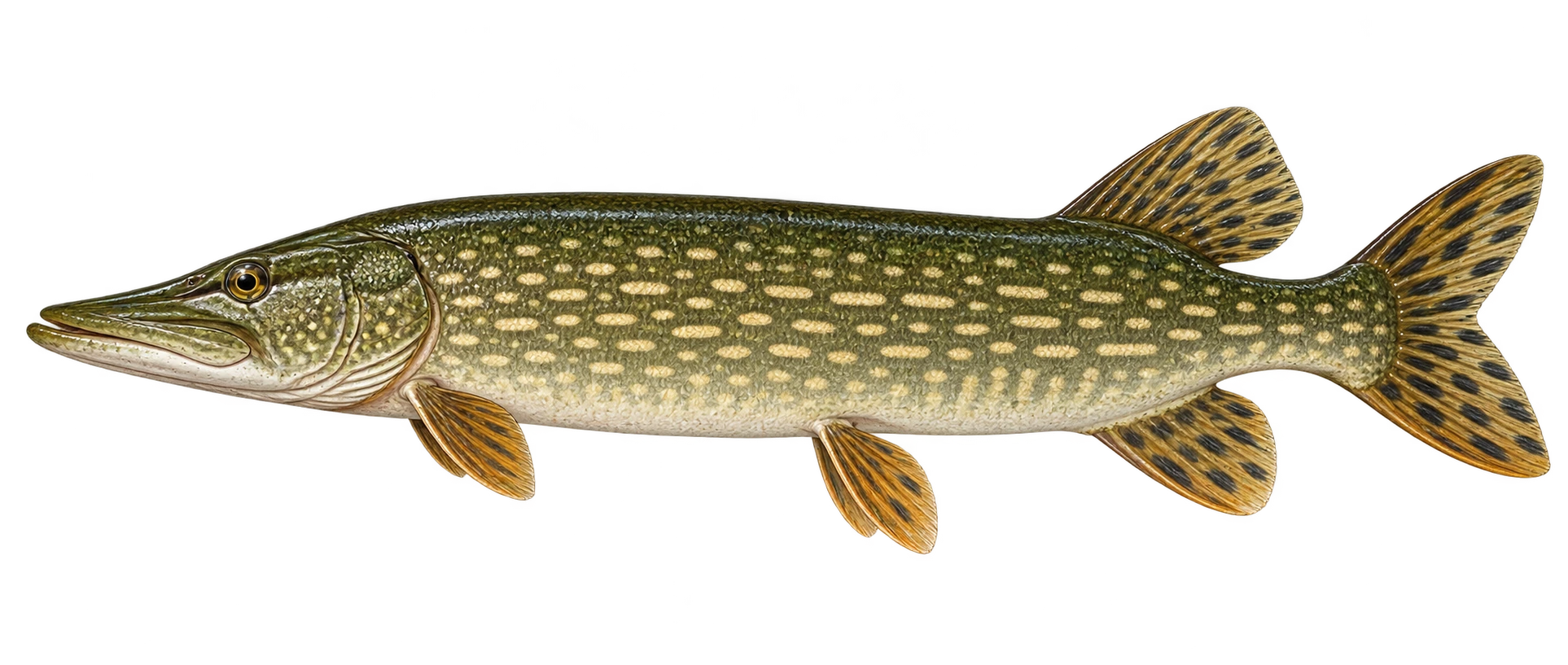
Pike are closer to even. In two English lakes, females carried about 17 600 to 19 400 eggs per kilogram whatever their size, so a 6 kg pike lays about as many eggs as six 1 kg pikes together: roughly 106 000 to 116 000. [3]
So letting one big pike go keeps as many eggs in the lake as letting six small ones go.
Big mothers do more than lay eggs
- Older females spawn at different times and places, so some young meet good conditions. [2]
- Old fish outlast bad years and spawn again when conditions improve.
- Where the big fish are taken out, stocks become less productive and less stable.
- In many species, bigger females' eggs hatch into young that grow and survive better. In the pike study, fry from big and small mothers were the same size. [3]
How to release well
- Land it fastUse tackle strong enough to bring the fish in quickly, and a soft knotless or rubber net. Never fight it to exhaustion.
- Wet hands, whole bodyTouch it as little as you can, with wet hands. Support the whole body. Never hang it by the jaw, and keep fingers off the gills and eyes.
- Under a minute in the airLess than 60 seconds out of the water is ideal. Have the camera ready before you lift it.
- Unhook in the waterPliers or a dehooker, ideally without lifting the fish out. Barbless hooks come out easier. If the hook is swallowed deep, cut the line close to it.
- Let it swim offIf it is slow, hold it upright facing into the current until it swims away on its own.
Guidance: NOAA Fisheries [4] Fish under the minimum size, or caught in a closed period, must go back by law. Check the rules [5]
Sources
- Fish reproductive-energy output increases disproportionately with body sizeBarneche, Robertson, White & Marshall · Science 360 (6389): 642–645 · 2018
- BOFFFFs: on the importance of conserving old-growth age structure in fishery populationsHixon, Johnson & Sogard · ICES Journal of Marine Science (University of Hawaiʻi summary) · 2014
- The reproductive success of pike, Esox lucius: aspects of fecundity, egg density and survivalWright & Shoesmith · Journal of Fish Biology 33: 623–636 · 1988
- Catch and release fishing best practicesNOAA Fisheries · viewed 28 Nov 2026
- Closed periods and locations for fishing, minimum sizesKeskkonnaamet (Estonian Environmental Board) · viewed 28 Nov 2026